The Alford American Family Association
Serving the Alford community over 25 Years
We Are Family!!
Click for CONTACT Information
|
The Alford American Family Association Serving the Alford community over 25 Years We Are Family!! Click for CONTACT Information |
| Last Updated: 23 SEP 2021 by #0197 |
|
Written in the early 1970s, this biography was given to me by Chleo in the early
1980s. Unfortunately, Chleo did not date this particular article; she just told me
she had written it "about ten or twelve years ago". -- Faye Lawes |
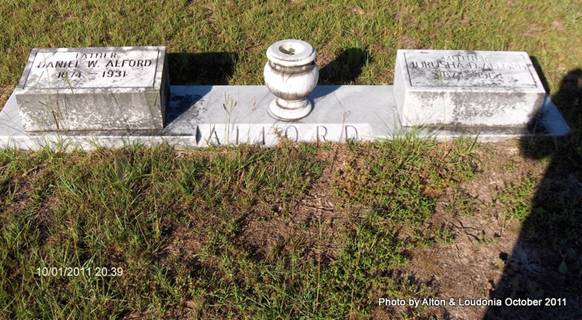
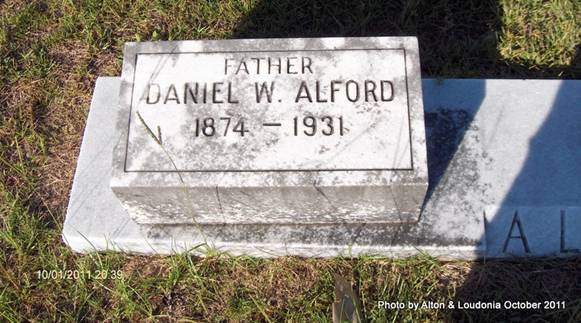
My father, son of Wiley Walton Alford, was born May 30, 1874, and died July 27, 1931. He was one of the six children born to the union of Wiley Walton Alford and Susan Elizabeth Morrison Alford. My grandmother was married to M. Morrison, who died in the service. He belonged to Regiment #4 when he was killed in the Civil War.
My father got his education in the Public Schools of Calhoun County, near Ocheesee (Florida). After my grandfather died, my father was very close to an older half-brother, Walton, that he went to live with who we called Uncle Buddie, as did my father. Uncle Buddie taught him quite a bit about farming and management. He worked on the farm and went to school to further his education.
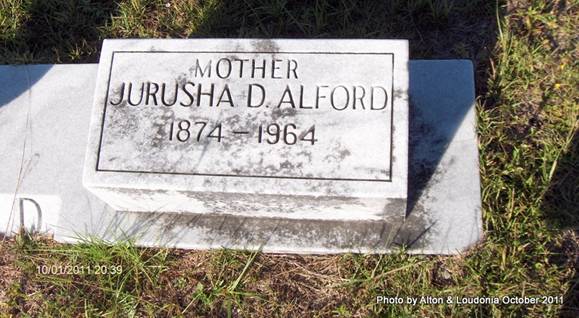
Later he met and married Jurusha Loucretia Dickson, my mother. She was the daughter of James Abner Dickson and Missourian Elizabeth Culverson. My mother was educated and taught in the Public Schools of Jackson County. She attended Florida Normals in Marianna, and in the old Chautaqua Building now in the process of being restored in Walton County, DeFuniak Springs, Florida. This was in 1893. In 1896, while teaching at the Old Comfort School, she and my father were married and as a bride he carried her over the threshold of a new house he had built at Ocheesee, Florida. He worked hard, cleared the land he acquired by Homestead Rites for farming. He had a cow, calf, a few chickens, a horse named Doag, and a buggy. This horse was a dark beige color, sprinkled with maroon colored spots, a very unusual color and animal. This horse must have had some Lippizzan strain from the way my father was able to train him.
Here they raised seven children, Leon Webster, Chleo Marie, Ruel Jurusha, Elon Daniel, Sibley Lee, Libby Jean, and Duncan U. Fletcher, and we all had our first buggy ride behind this horse, Doag, from 1898 to 1916.
We children went to Public School at Ocheesee, Florida, through the eighth grade, then to other schools nine through twelve. My brother, Leon was attending high school in Altha, Florida, when stricken with acute appendicitis. He died May 20, 1916.
My father sent me, Chleo, to Chapman High School in Apalachicola, Florida and I boarded with close friends of the family, the Griffins. They requested cured pork hams, cane syrup and corn meal as pay for my board as these items were hard to get in the town of Apalachicola. My means of transportation was the River Steam Boat, named the John W. Callahan. Mr. McGruder was the boat captain from Columbus, Georgia to Apalachicola. I was placed in his care and when I came home on weekends, Captain McGruder would blow a signal at Rock Bluff and by the time the boat landed my father would be there to pick me up. While attending school there, I took the teacher’s examination under the flying squadron, and decided to teach. I taught school for two years; first school at Frink, Florida, second at Graceville, Florida. After two years I decided to enter Nurses Training at the Florida State Hospital. I retired after thirty-three years of service.
My father worked hard and was a very successful farmer. He was considered quite prosperous in those days. He belonged to the Florida Cane Growers Association and some years there were over a hundred barrels of syrup that went to the market from our farm.
My father’s hobbies consisted of many things such as making his own syrup barrels, logging, carpentry, and even music. He blew what was called a harp in those days, and one of my favorites was "Boil Them Cabbage Down". I shall never forget the day I came home from school and he said to me, "I bought you something, come and let me show it to you." A beautiful new Adler Organ! I was never so happy in all my life as I was that evening. I could not do my evening chores from running back and forth to look at what I thought was the most beautiful organ I had ever seen. Believe it or not, I used to play the organ for church.
Speaking of carpentry, you should see the home of my brother, Ruel. A beautiful example of what his hands can do with brick, saw and tools.
Ruel Jurusha Alford’s Military Record:
C.M.T.C. Camp McClellan, Anniston, Alabama 1923 Camp - Basic Course Army Military Training 1924 Fort Baroncas, Pensacola, Florida 1925 Camp - The Red Corps in Navy Camp - The White Corps in Navy July 6, 1942 Norfolk, Virginia - Eng. H.E.P. Dept. Naval Operating Base 1948 Transferred to Cheatam Annex, Williamsburg, Virginia 1952 Transferred to York Town, Virginia Naval Weapon Station 1953 Transferred to Fort Eustis, Virginia, for Post Engineers as Heavy Equipment Operator and retired from this service, February 28, 1969
After he retired he worked for the State Mental Hospital, Eastern State from June 1970 to November 1970. He later worked for Colonial in Williamsburg, Virginia from December, 1970 to April of 1971.
My brother, Elon, is quite good with pipes, just tell him which way you want the water to go, and he can put them in straight, up, down or all around.
Just give my sister, Libby, a sewing machine and she is a whiz. She has many talents. She won a trip once, making and modeling a suit for the best dressed woman in her club.
My brother, Fletcher, still has the logging business in the family. He can fell a big pine tree in a four foot path, and miss every little Dogwood tree within six inches, and does not have to have a helicopter to take them straight up either.
Duncan U. Fletcher Alford’s Military Service Record:He received the European African Middle Eastern Theater Medal with three bronze stars, Good Conduct Medal, Presidential Citation presented for service above and beyond the call of duty, the Distinguished Unit Badge and Purple Heart.
- January 9, 1944
Entered Armed Service - Camp Blanding, Florida - was sent to Camp Croft, South Carolina for Boot Training (Captain Jones in Command). He was sent to Hattiesburg, Mississippi for special training and to Boston, Massachusetts to prepare for overseas duty (Overseas Captain was Captain Manuel).
- July 25, 1944
Left Boston via route of New York and arrived in Liverpool, England, August 2, 1944. He served in the European Theatre in France, Belgium and Germany.
- November 20, 1944
Injured in the Hutchinson Forest and was sent to France and hospitalized at the American Hospital in Paris, November 22, 1944.
- December 6, 1944
Transferred to 81st General Hospital in England. He was sent back to the states on the Queen Mary and landed in Staten Island, New York. He was sent to Brooks General Hospital in San Antonio, Texas.
- May 20, 1945
Discharged with Honorable and Disability Discharge (Commanding Officer at time of discharge, Col. William A. McCally).
My father’s workshop was a most complete one in those days. In fact, it was so well equipped that one of its kind was called a rarity and most popular. He had tools to build houses, barns, make syrup barrels, log carts and ox yokes. The worn out buggy axles were used to make unique fire-dogs to hold wood in the fireplace. In fact, I have a pair my brother Sibley made patterned from the ones my father made. Sibley was quite talented making and repairing things as was my father.
In the fall of the year after the farming and logging were finished, my father would start making his syrup barrels. In the late evening his last chore for the day was setting up and shaping a barrel to be finished the next morning. For this process he built a basket from scrap hoop iron, which was used around the barrels to hold and mold their shape. In this basket he would place just the right amount of shavings from planing the staves, set up the barrel, place it over the lighted basket; then from a bucket of water, using a short handled mop, he would wet the inside of the barrel. When the wood was heated to the right temperature to bend and shape, he would remove it from the fire basket and shape it into a perfect barrel. Very few did I ever see leak when filled with syrup.
My father liked people, and our home was visited quite often, especially during election time. They could always time a stop at the Alfords about 11:00 o’clock just in time for the noon meal. My mother was an excellent cook as they had learned the years before. Papa, as we always called him, would call one of my brothers to take care and feed the horses while the men talked politics. Mamma and I peeled a few more potatoes, made an extra pan of biscuits, and sliced more tomatoes to add to the dinner.
The first night I can remember my father staying away from home was when he was on jury duty. (They never missed calling him.) This particular time the jurors did not bring in the verdict and were locked up in the juror box overnight. I thought when the word came that they said that my father was locked up in jail and I pitched a "doozy". Mamma had quite a time with Chleo and had quite a bit of explaining to do.
My father always invited the preachers, as they were called in those days, to be our guests. Once there were two Presbyterian preachers who came to have a revival, the Reverend Sam Sibley and the Reverend Arthur Lee. They were guests in our home. This was just before the fourth son was born, and when he arrived he was given the name of Sibley Lee Alford. (Sibley Lee Alford died March 7, 1965.)
My father liked to read and three times weekly he received by mail The Atlanta Constitution. Rain or shine, there was always a trip to the mail box on those days. The social column was written by Miss Laura Jean Libby and always fascinated him. So, when the stork arrived again that is where they got the name for Libby. My father always admired U.S. Senator Duncan U. Fletcher so my parents named their last son for him.
Papa also liked to read Zane Grey’s books and when his health failed he enjoyed many hours reading his favorite books. When I lived too far away to visit my family I would mail my father books to keep him happy.
I was very fond of my father, in fact, all of his family.
Uncle Henry’s home is a pleasant memory, Aunt Dora sending Lessie, Thelma, Burrell and I to the well to wash greens, five times in fresh water. Burrell was to draw the water so he suggested after we did four waters that we put them back through the fourth and that would be five times, but we did not.
Other pleasant memories include visits to Uncle Buddie’s and Aunt Lula’s home, where we spent many happy hours listening to probably the first phonograph in the community and chewing sugar cane.
I loved my visits to Aunt Emily’s home, her home cooked meals in the fireplace and her alarm clock. Her clock was a hand full of corn on the back porch after the chickens had gone to roost so that the "peck, peck" would wake her up early when she had to go meet the mail man and the rolling store.
Aunt Emmaline and Uncle John lived near us and they were a very devoted couple. They did not visit like the rest of the family. Uncle John was of Catholic faith and there was not a church nearby. They were very close friends of the Gregorys, the founders of the Old Gregory mansion at Torreya State Park, but then it was located on the other side of the Apalachicola River.
A friend, George Atkins, who I grew up with, was a Principal of Public Schools. He liked to do history research on prominent families and chose the Joseph P. Kennedy family. He learned that Uncle John was a distant relative of Joseph P. Kennedy. I did know that Uncle John was Irish and his family came from Ireland and to Florida, from the State of Massachusetts. I can remember very well a few of his peculiar traits, such as a by-word "By-Cheminie" he used when aggravated and would put just one spoonful of Gulano as it was called in those days, to each hill of corn. He would say jokingly if everybody had been like him they would have all wanted Emmaline. He was well educated and had a very peculiar sense of humor.
I loved to visit Aunt Jessie Wimberley’s home and the nearby pool where we went swimming.
And, to visit Aunt Lizzie Teat’s home and eat the good syrup tea cakes she could make.
I remember my father attending the funeral of Uncle Bynum at Kissimmee, Florida, and his son, Lester and daughter, Maude, coming to visit us.
Two brothers, Daniel and Halcourt [sic: Wiley Holcott], married two sisters, Rusha and Zillah.
I remember Uncle Halcourt [sic: Wiley Holcott] and Aunt Zillah and the pot that cooked at least a ton of lima beans. Uncle Halcourt [sic: Wiley Holcott] hauled more logs than the Apalachicola River could hold.
Uncle [Jasper] Allen died young, serving his country in the Civil War.
Aunt Annie died in 1901, the year before I was born. Her children, especially Bessie, and I have many pleasant memories of the past.
I was very close to my father and at times we had quite lengthy conversations. The principles of life my father taught his children to follow and to live by were quite unique. I have found them to be very helpful to follow throughout the years.
Thanks to my father, mother and family for a life filled with wonderful memories. From this family of seven children there are nineteen grandchildren and forty-one great grandchildren.
It would be wonderful to have a history from the other eleven sons and daughters of my grandfather to add to this.
GRAVESTONES
Photos from, www.findagrave.com
Shady Grove Cemetery, Grand Ridge, Jackson Co., FL
Permission granted by the photographers, Alton & Loudonia