The Alford American Family Association
Serving the Alford community over 25 Years
We Are Family!!
Click for CONTACT Information
|
The Alford American Family Association Serving the Alford community over 25 Years We Are Family!! Click for CONTACT Information |
| Last Updated: 23 SEP 2021 by #0197 |
From the late 1800s to the early 1900s, Dean Alvord was a prominent and innovative real estate developer in New York and Florida. Areas and buildings that he developed are on the National Historic Register, and residents still treasure them.
Descendant of Alexander Alvord
Dean Alvord is listed on pages 520 and 644-645 in Samuel Morgan Alvord’s A Genealogy of the Descendants of ALEXANDER ALVORD An Early Settler of Windsor, Conn. and Northampton, Mass. (Webster, NY: A.D. Andrews, Printer, 1908). At the time of publication, Dean and his family were still living in Brooklyn. The following information, unless otherwise noted, is from that book.
Dean Albert Alvord was born 4 Dec 1856 in Syracuse, NY, the son of James Dwight Alvord and Caroline Louise Edwards.
He married Nellie Barnum, daughter of Abijah and Abigail (Bryant) Barnum on 11 March 1885. She was born in Ovid, NY, 15 July 1863.
Dean graduated from Syracuse University in 1882. For eight years he was general secretary of the Y.M.C.A. at Rochester, NY. He then moved to Brooklyn and was devoted to the development of real estate. His interest in the civic improvement was evidenced by the character of the real estate developments with which he was connected. He gained a reputation in the matter of beautification of city streets and stimulated interest in suburban improvement by offering prizes for the best kept yards, most beautiful window gardens, etc. He was president of Dean Alvord Company and a member of the Municipal Art Society, the Municipal Club, the Hardware Club and the Lawyers Club of New York City.
Children: (all born in Rochester, NY, except the last one, who was born in Brooklyn, NY)
- Harry Alvord, born 12 June 1886 and died 9 Dec 1886.
- Donald Alvord, born 27 Feb 1892. The Social Security Death Index reports his death in August 1977 in St. Petersburg, Pinellas Co., FL.
- Evelyn Alvord, born 24 Apr 1893.
- Mildred Alvord, born 18 Apr 1897 and died 7 May 1898.
- Eric Alvord, born 29 Sept 1903. The Social Security Death Index reports his death in May 1979; the zip codes given for his residence, 33942, and last benefit, 33940, do not exist. Perhaps they should be 33742/0, which are for St. Petersburg, FL, where Eric’s brother Donald also lived.
************************************************************************
On the 1900 census Dean Alvord’s family resided on Albermale Road in Brooklyn; the family consisted of Dean 43, "Millie" 39, Donald 8, Evelyn 7 and sister Octarva Holman 29.
Sometime after 1910, Dean moved his family to Clearwater, Pinellas Co., FL. (We have not located the family on the 1910 census.)
In 1920 the family was at #315 Harbor Oaks Street in Clearwater, Pinellas Co., FL, dwelling #523: Dean Alvord, real estate manager, 63; his wife Nellie B. 56; and children, all single: Donald 27, Evelyn 26 and Eric 13. All and their parents were born in NY.
In 1930 they are on Magnolia Drive in Clearwater (District 46), Pinellas Co., FL, dwelling #117: Dean Alvord, real estate capitalist, age 74 b. NY; his wife Nellie B. 66 NY; son Donald 38 (single) NY; and 2 unrelated servants. In dwelling #116 is the family of Robert S. Brown, who later bought the Alvord house [see below].
Dean and his wife do not appear in the SSDI. The Newsday article below states that Dean Alvord died in 1937. The Florida Death Index, 1877-1998 (Ancestry.com), lists a Dean Alvord who died in Tampa, Hillsborough Co. in 1941, but no other identifying information is provided. No Alvords were found living in Hillsborough Co. in 1930, but between 1938 and 1943, four Alvords are listed on the Death Index in Hillsborough Co., all with death dates only: Lucy F. Alvord 1938, James Church Alvord 1939, Dean Alvord 1941, Donald M. Alvord 1943.
************************************************************************
Dean Alvord’s Real Estate Developments
- - - - - - - - - - - - - - NEW YORK - - - - - - - - - - - - - -
- - - - - Long Island - - - - -
Newsday
9 December 2003
HIS HEART BELONGED TO BELLE TERRE
By Rhoda Amon, Staff Writer
"There is nothing quite like Belle Terre in the world," stated the elegant brochure created by the Dean Alvord Co. in 1910 to promote its exclusive summer colony on Port Jefferson Harbor. It might also have said there was no developer quite like Dean Alvord.
True, Alexander T. Stewart, the department store tycoon who founded Garden City, envisioned a model community, as did other 19th Century Long Island developers. But when it came to the quest for the ultimate in architectural and community beauty, "the perfect home in perfect surroundings . . . where every landholder is a king," in that respect, even Stewart was no Dean Alvord.
Alvord cut a swath of luxury living across Long Island even before he reached Belle Terre, and at one point he owned 10 percent of the Long Island shoreline. He began in Brooklyn in 1898, acquiring a large tract near Prospect Park. A tall, courtly, professorial man, he was then 42 and had come from Syracuse, where he taught at Syracuse University and then settled into a job as general secretary of the Rochester YMCA. At some point, the YMCA secretary decided the time was right to move to New York City and build "perfect homes" for people who could afford perfection.
Alvord’s Prospect Park South was no Levittown. Each house was designed as a separate entity, and Alvord’s architectural staff could turn out homes in Colonial Revival, Italianate, French Renaissance, Elizabethan, Jacobean, Japanese or Spanish Mission style. To ensure a park-like atmosphere, Alvord buried all utility lines and required that all houses be set back behind large front lawns, a pattern he continued across Long Island.
Alvord formed a syndicate that purchased land from Long Island City in Queens to Shinnecock Hills on the East End. In 1906, the company built an upscale housing development that became the village of Roslyn Estates. It’s still a classy enclave with winding tree-shaded roads and a median home value inching toward $700,000.
But it was to Belle Terre that Alvord brought his whole heart and much of his money. He bought a triangular tract called Mount Misery Neck from the bankrupt Port Jefferson Co., which had purchased the old Strong family estate with hopes of developing it.
"Alvord paid $650,000 for the 1,300 acres plus $100,000 for the improvements which the original company had completed," historians Gordon Welles and William Proios reported in their book, "Port Jefferson, Story of a Village," published by the Historical Society of Greater Port Jefferson.
Retaining the name Belle Terre (French for "beautiful land") that the earlier developers had chosen, Alvord set out to create an exclusive hideaway for the city’s aristocracy. Prospective land buyers were soon arriving from the city in a private railroad car provided by Alvord’s close friend, Ralph Peters, then president of the Long Island Rail Road.
Alvord bought land alongside the old brick railroad station and had his architects, Pettit and Green, design a white columned neoclassical temple for the visitors to alight in. He also built a road from the station to carry them in style to the gates of Belle Terre. "No expense was spared," said his great-granddaughter-in-law, Lynn Flaster Alvord.
Dean Alvord could never be accused of cutting corners. He would insist that even his ledgers be bound in the finest leather with real brass corners.
The three-story Belle Terre Clubhouse, styled as an English inn, was the focal point of the colony. Set on a 200-foot bluff overlooking the harbor and the town, the clubhouse had accommodations for 100 with a fireplace in every room, a dining room that could seat 200 and serve the finest cuisine and a barber shop and billiards rooms in the basement.
Outdoors, there were miles of bridle paths, tennis courts, golf courses, a croquet ground, bowling green and a private garage to service the motoring set.
As many as 100 carpenters worked on the clubhouse alone. The Port Jefferson Echo ran a "Belle Terre Notes" column keeping local citizens posted on the project’s progress and its burgeoning job market.
Only those of "good social standing" would be eligible for membership, and they would be safe from "inharmonious elements" because no one could enter the grounds without an invitation card. Despite these promises to keep out the hoi polloi, Alvord’s promotional literature denied any snob appeal, dwelling on congeniality. "Here are scores of people of moderate means whose recognized social prominence is due to their refinement and lovable personality," the disclaimer read.
Belle Terre would become the most selective colony this side of Newport, R.I., attracting industrial and financial barons such as J.P. Morgan, known more for his wealth and power than his lovableness. At its height, Belle Terre counted membership from among the Vanderbilts, Whitneys, Goulds, Huntingtons and Astors.
Alas, there were not enough solvent aristocrats in the tumultuous economy preceding World War I. Alvord’s original concept of a few very exclusive estates gave way to a subdivision of six-to-eight-room "bungalows" and 10- to 15-room "country houses."
"Despite an expenditure of more than $1,000,000, the development corporation went into receivership in 1913," Welles and Proios reported. "Before its demise, however, Alvord and his colleagues were able to establish an exclusive retreat the like of which Long Island was not to see again."
Undeterred and still in pursuit of beautiful architecture and landscaping, Dean Alvord left Belle Terre and toured Asia with his son, Donald, in 1913. The Alvords settled in Clearwater, on Florida’s west coast, and created Harbor Oaks, the area’s first planned residential development. Alvord’s waterfront estate, Eagles Nest, had a Japanese teahouse that became a tourist attraction.
Belle Terre succumbed in the 1920s to sand mining operators who gouged out huge chunks of land. The remaining wealthy residents incorporated as a village in 1931 to stop the sandmining and ban commercial activity.
Alvord died in 1937. The clubhouse burned down in 1934 and the pergolas were washed away in the 1938 hurricane. But some Tudor mansions remain in what was called "the English section," says village historian Nancy Orth, who was born there in 1940. Tree-shaded streets and spacious homes on wooded acres make Belle Terre still a "lovely place to live," Orth says. That, in the end, was Dean Alvord’s Long Island legacy.
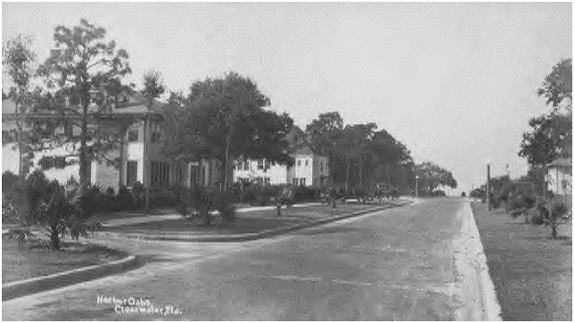
- - - - - Flatbush and Prospect Park South - - - - - Harbor Oaks was the first modern master planned development in Clearwater…. The vision of Harbor Oaks was realized by a New York developer by the name of Dean Alvord in the early 1910's. Initially, Alvord wanted to winter in the Clearwater area and wanted to purchase a lot in the area which is Harbor Oaks. E.H. Coachman who was the owner of the Harbor Oaks land at the time sold all of the land to Alvord because he would not subdivide the land. Alvord decided to develop the remainder of the land into an exclusive neighborhood with modern amenities that would attract the wealthy to the area. Due to his New York connections he ended up enticing many wealthy New York natives and wealthy locals to the area.
FLATBUSH, THE HEART OF BROOKLYN
By Nedda C. Allbray, 2004
This book is available at Amazon
It contains a somewhat lengthy discussion (page 140-142)
of Prospect Park South and Dean Alvord’s part in its development.
Wikipedia’s article on Prospect Park South, Brooklyn also has
information about the Dean Alvord, along with some photos of the area.
- - - - - - - - - - - - - - FLORIDA - - - - - - - - - - - - - -
- - - - - Clearwater, Pinellas County - - - - -
Enchanting Harbor Oaks, with photos
Historic Homes of the Gulf Coast & Tampa Bay Coast
By Tiffany Metzig
23 July 2010
The first home that Alvord constructed was his own estate located at 802 Druid Road. Later purchased by Robert Brown who added two additional wings, created lush gardens and referred to it as Century Oaks. Dean Alvord constructed his next estate in Belleair at the corner of Rosery Road and Eagles Nest Drive and constructed lavish gardens referred to as the Eagles Nest Japanese Gardens. The home and gardens have since been demolished and the land was subdivided and newer homes exist at the location. His brother [sic: son], Donald Alvord who promoted and sold homes in Harbor Oaks, constructed the estate at 208 Magnolia Drive. The grand estate at 205 Magnolia Drive is the Harrison/Plunkett House.
The area has attracted many famous and wealthy people such as:
- Donald Roebling, the great grandson of John Roebling (and grandson of Washington Roebling) who engineered the Brooklyn Bridge. Donald Roebling was the inventor of the Amphibian "Alligator". He constructed a tudor style estate adjacent to Century Oaks at 700 Orange Avenue in Spottis Woode.
- James Studebaker III, automaker heir and banker.
- Charles Ebbets, owner of the Brooklyn Dodgers.
- M.A. McMullen, attorney and son of one of the pioneering families.
- Taver Bayly, local citrus businessman and banker.
- Sewell Ford, writer.
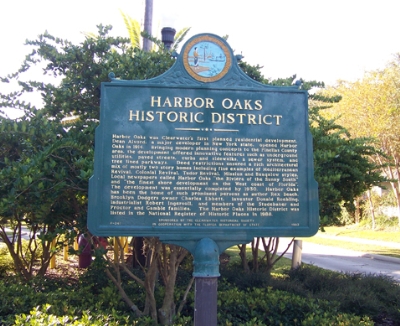
Harbor Oaks Historical District
Clearwater, FL
U.S. National Register of Historic Places
Text on the sign:
Harbor Oaks was Clearwater’s first planned residential development.
Dean Alvord, a major developer in New York state, opened Harbor Oaks
in 1914. Bringing modern planning concepts to the Pinellas County area,
the development offered innovative features such as underground utilities,
paved streets, curbs and sidewalks, a sewer system, and tree lined parkways.
Deed restrictions ensured a rich architectural mix of mostly two story homes
including fine examples of Mediterranean Revival, Colonial Revival, Tudor
Revival, Mission and Bungalow styles. Local newspapers called Harbor Oaks
"the Riviera of the Sunny South" and "the finest shore development on the
West coast of Florida". The development was essentially completed by 1930.
Harbor Oaks has been the home of such prominent persons as author
Rex Beach, Brooklyn Dodgers owner Charles Ebbett, inventor Donald Roebling,
industrialist Robert Ingersoll, and members of the Studebaker and
Proctor and Gamble families. The Harbor Oaks Historic District
was listed in the National Register of Historic Places in 1988.
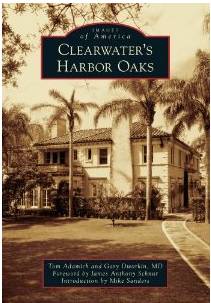
Clearwater’s Harbor Oaks
By Tom Adamich and Gary Dworkin
Arcadia Publishing, September 2013
Also available from Amazon